KOLKATA
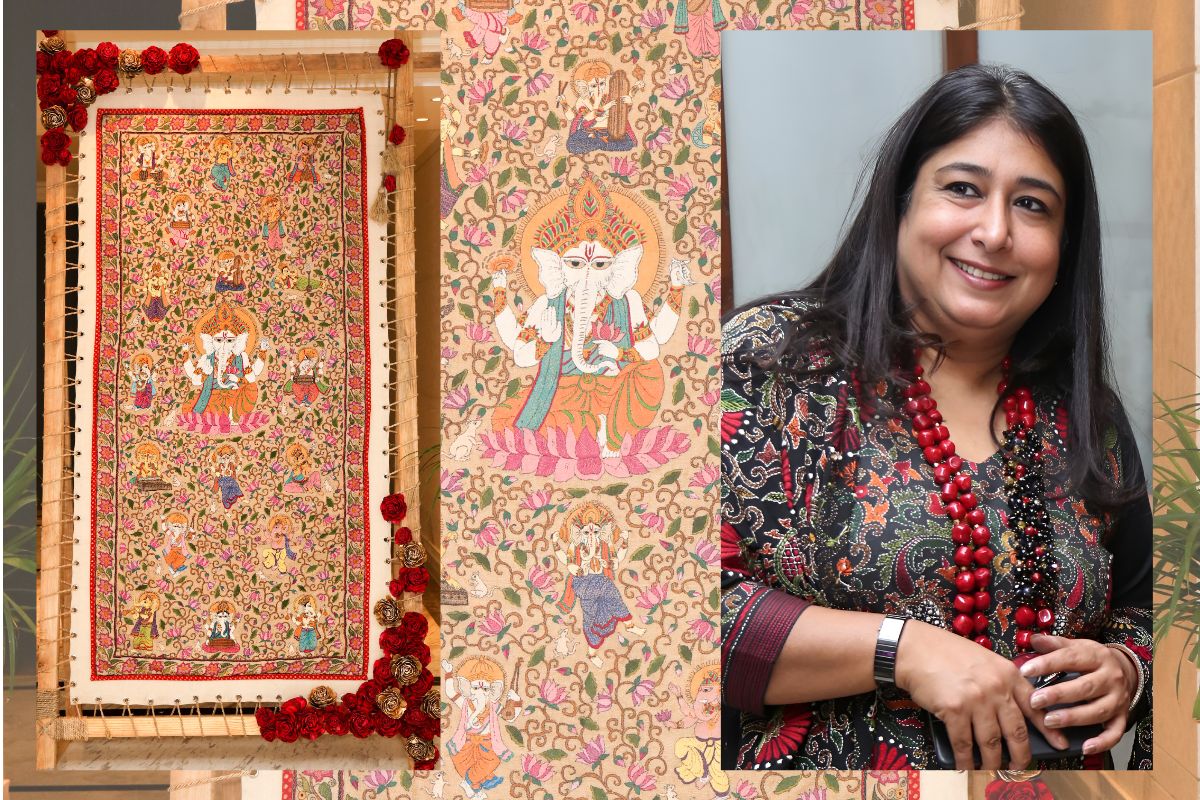
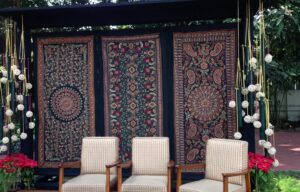
Perhaps Kantha has been living in too small a world. For something capable of holding stories, landscapes and generations of memory within a few millimetres of thread, its place in the contemporary home has remained surprisingly contained. Folded over a bed, placed on a sofa, worn on the body. Malika Dudeja Varma would rather unfold it completely and see what happens when Kantha is given a wall, a piece of furniture, a screen, perhaps even a room.
At SHE Kantha, the running stitch is being considered less as embroidery applied to something and more as a material with spatial possibilities. A headboard could be composed through thread rather than upholstery alone. Thousands of stitches could spread across a wall like a drawing. A screen could tell a story from either side. At architectural scale, repetition becomes rhythm, empty fabric becomes deliberate pause and the individual hand remains visible even within something monumental.
“The stitch itself has never been limited,” explains Malika. “It is incredibly versatile, tactile and expressive. The limitation was really in how we had come to perceive it.”
That distinction sits at the heart of SHE Kantha. The ambition is not to modernise Kantha by disguising its origins, nor to scatter it indiscriminately across contemporary furniture. It is to change the scale of the conversation around it. The story began much earlier. In the 1980s, Shamlu Dudeja started working with rural women in Bengal, building livelihoods around a skill many had learnt within their families. What followed was not simply an exercise in keeping an old technique alive. It gave women’s work economic value, visibility and continuity.
Years later, SHE Kantha is asking what the next life of that knowledge might look like. “A Kantha piece can be a drawing, a painting, a narrative or an installation, depending on how it is conceived,” Malika says. “Once we started thinking of the stitch as a medium rather than a technique, the possibilities became much larger.”
For a long time, Kantha entered the home through familiar routes: quilts, throws, cushions and bedspreads. Varma sees no reason for its journey to end there.
“A Kantha piece can be a drawing, a painting, a narrative or an installation, depending on how it is conceived,” she says. “Once we started thinking of the stitch as a medium rather than a technique, the possibilities became much larger.”
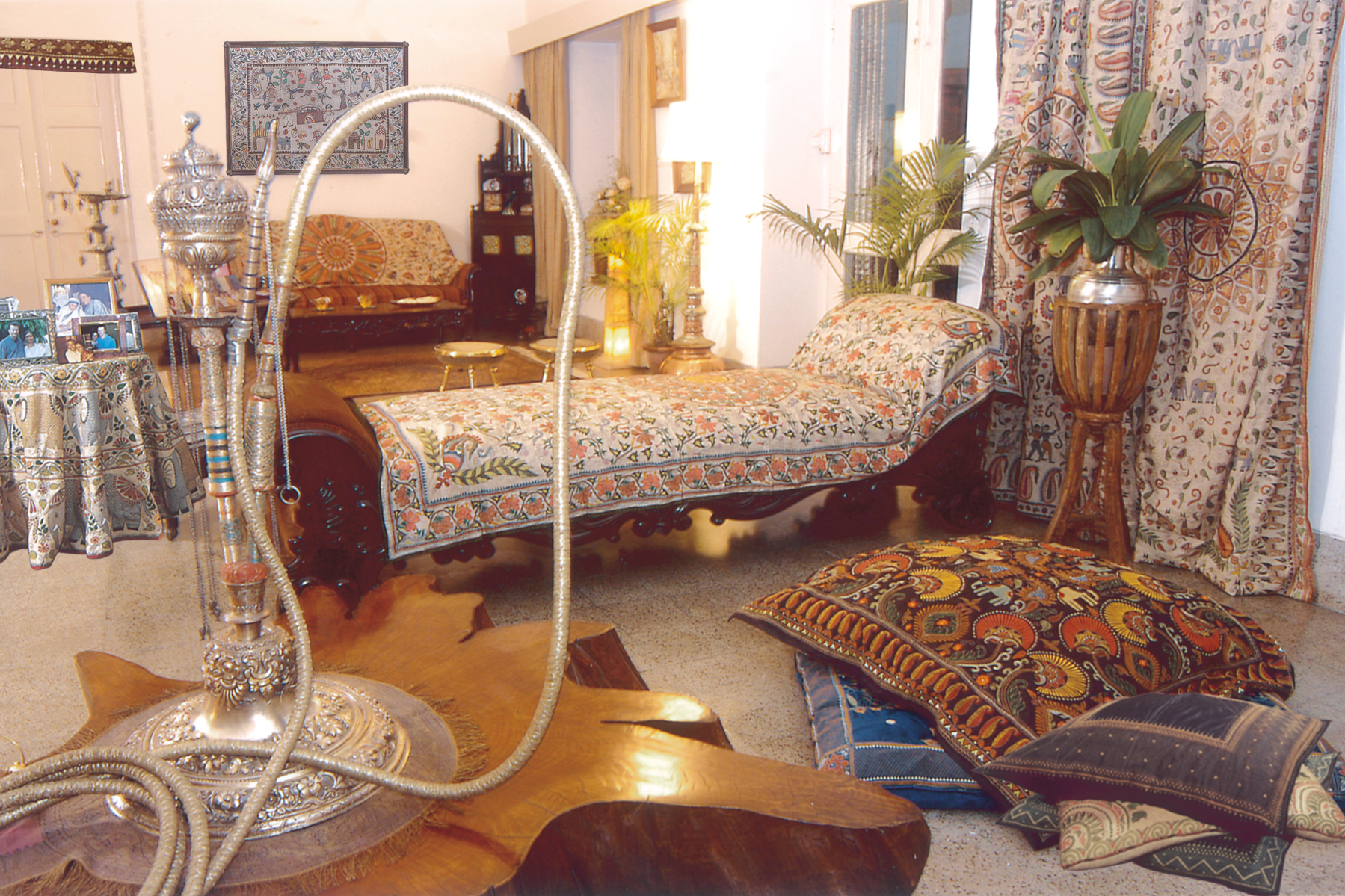
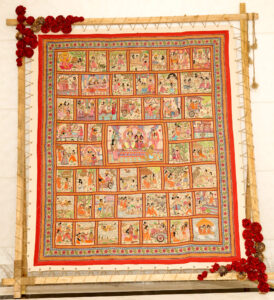
Imagine a headboard drawn entirely in thread. A screen whose surface carries thousands of hand-worked marks. A large wall panel where the embroidery is read not as ornament but almost as a mural. Upholstery, panels and spatial installations are all being considered, but with one important caveat.
“The idea is not to put Kantha onto every possible object simply because we can. The application has to respect the character of the stitch and allow it to remain the hero.”
It is an important distinction. Taking craft into contemporary interiors does not have to mean covering everything in it.
Scale changes Kantha in fascinating ways. Something intimate enough to be examined between the fingers suddenly has to hold a wall. A small motif cannot simply be enlarged and expected to retain its power. Composition becomes more architectural. Empty areas matter. So does the distance from which the work will be viewed.
“At larger scales, we have to think about rhythm, negative space, proportion, colour balance and how the eye moves across the entire surface,” Malika states.
There are practical questions too. A piece intended for an interior has to live with sunlight, touch, scale and prolonged use. Yet making it suitable for architecture cannot iron away the very irregularities that give Kantha its life. Machine-made surfaces repeat flawlessly. Kantha does not, and should not.
Perhaps SheKantha’s most interesting proposition is not about scale at all. It is about identity. Kantha carries Bengal within it, but Varma is wary of treating heritage as a fixed set of motifs that must be reproduced forever.
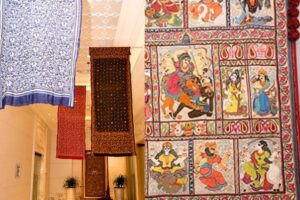
“Heritage is a starting point, not a visual prescription,” she says. Nature, mythology and village life remain part of the vocabulary, but so can geometry, architecture, contemporary art or something noticed during an ordinary day. The aim is not to strip Kantha of Bengal, but to give its Bengali inheritance enough confidence to evolve.
“The objective is not to make something that looks ‘Indian’. It is to make something that is authentically Kantha and yet completely at home in a contemporary space anywhere in the world.”
That thought frees the craft from nostalgia. A Kantha wall need not announce itsprovenance from across the room. The Indianness can reside in the hand, the knowledge and the making.
Look closely at handmade embroidery and no two stitches behave exactly alike. One pulls tighter. Another wanders fractionally. The rhythm changes with the person holding the needle.
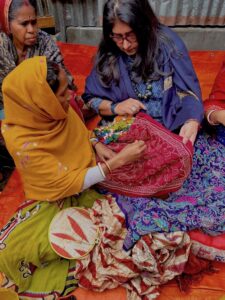
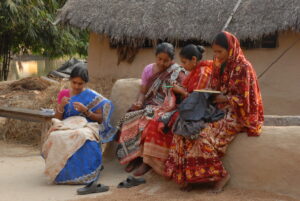
SheKantha has no desire to correct that humanity out of the work. “The composition and colour have to feel considered, but the work should never become so perfect that it loses the character of the hand,” says Malika.
That hand belongs to women whose visual references are often gathered from the world immediately around them: ponds, flowers, birds, trees, folklore, village homes and religious stories. Many learnt the stitch within their families rather than formal classrooms.
Crucially, their position is changing too. “They are not only executing someone else’s design,” Varma says. “Increasingly, their skill, interpretation and individual hand become part of the creative process.” The maker, then, is not anonymous labour hidden behind a finished piece. Her choices remain visible in it.
SheKantha resists a neat label. It is part design house, part craft practice and part social enterprise. Varma would rather those identities remain intertwined.
“Beautiful design and meaningful livelihood are part of the same story,” she adds. Architecture and interiors could make that story considerably larger. A cushion requires one kind of labour; a wall-sized commission asks for another order of skill, planning and time. If architects and interior designers begin treating Kantha as a serious material for spatial work, the value attached to the artisan changes with it.
“It can create more sustained employment, better incomes and opportunities for women to work at a larger and more ambitious scale,” says Malika.
There is also a younger generation watching. An inherited skill is easier to abandon when its future appears confined to the past. Far harder when that same stitch can enter contemporary homes, galleries and architecture across the world. Perhaps preservation, then, is the wrong ambition. A living craft does not need to be kept exactly where history left it. Give it a larger surface, a different room and another generation of hands, and the running stitch can simply keep running.