KOLKATA
Punjab has never been shy of grandeur. Princes, royalty, British influences and design are part and parcel of its architectural memory. They survive in the sweeping staircase, the formal drawing room, the chandelier, the polished timber door and, perhaps most of all, in the belief that a home should know how to receive people well.
But grandeur, like fashion, changes its colours. The Bridgerton greys and aristocratic blues have not entirely disappeared. At Cove House in Amritsar, they simply find themselves in rather different company. Emerald velvet enters the drawing room. Powder blue settles onto a deeply tufted bed. Blush pink appears on a pair of bedroom chairs. Cream, champagne, warm brown and soft grey move quietly through the rest of the house. What might once have been a darker, heavier interior has been opened to sunlight, lawns and great stretches of glass.
Designed by Harkaran Singh Boparai, Founder and Principal Architect of Harkaran Boparai Studio, Cove House is an interesting study in what happens when Punjab’s instinct for the grand meets a generation that wants its homes to breathe.
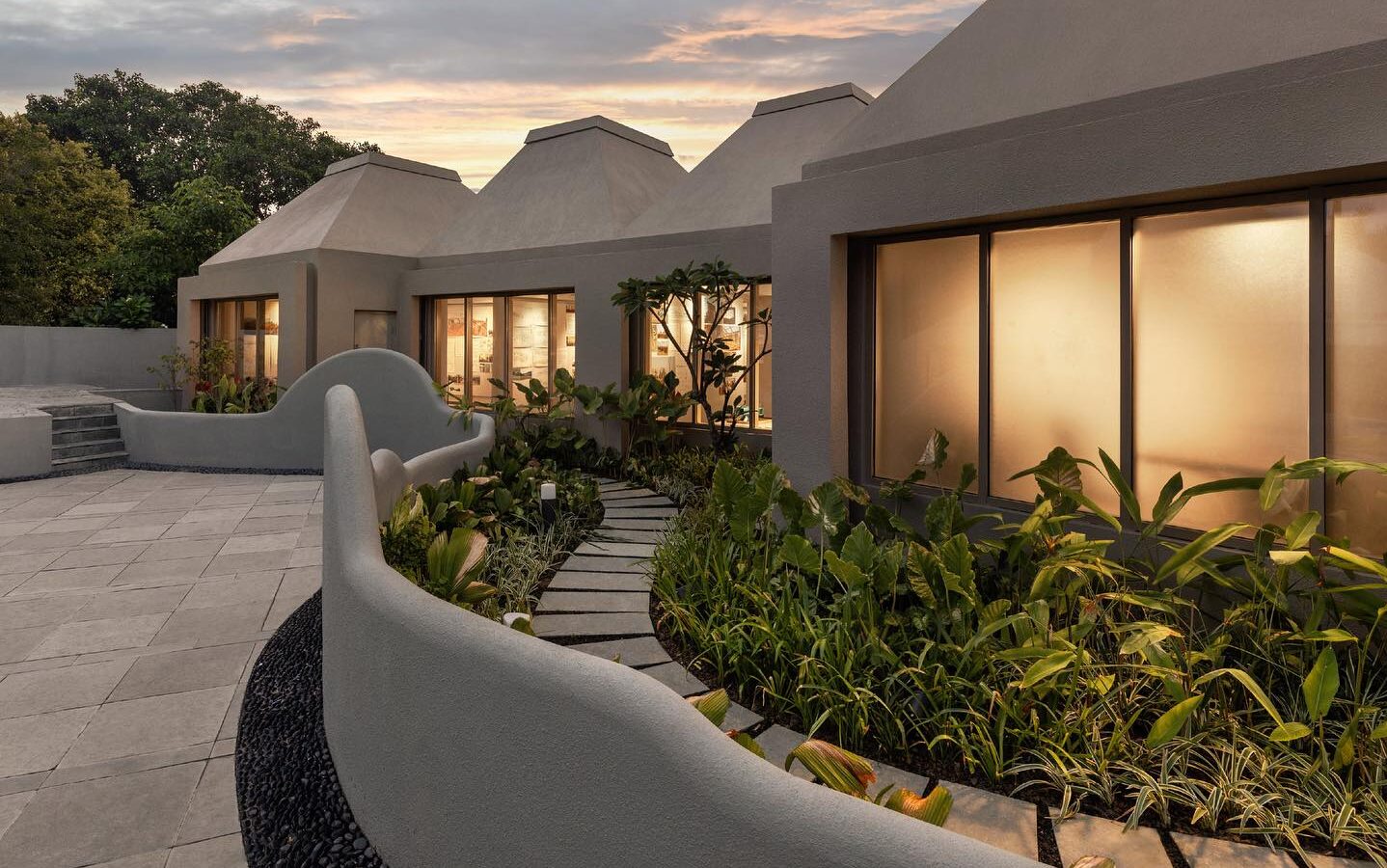
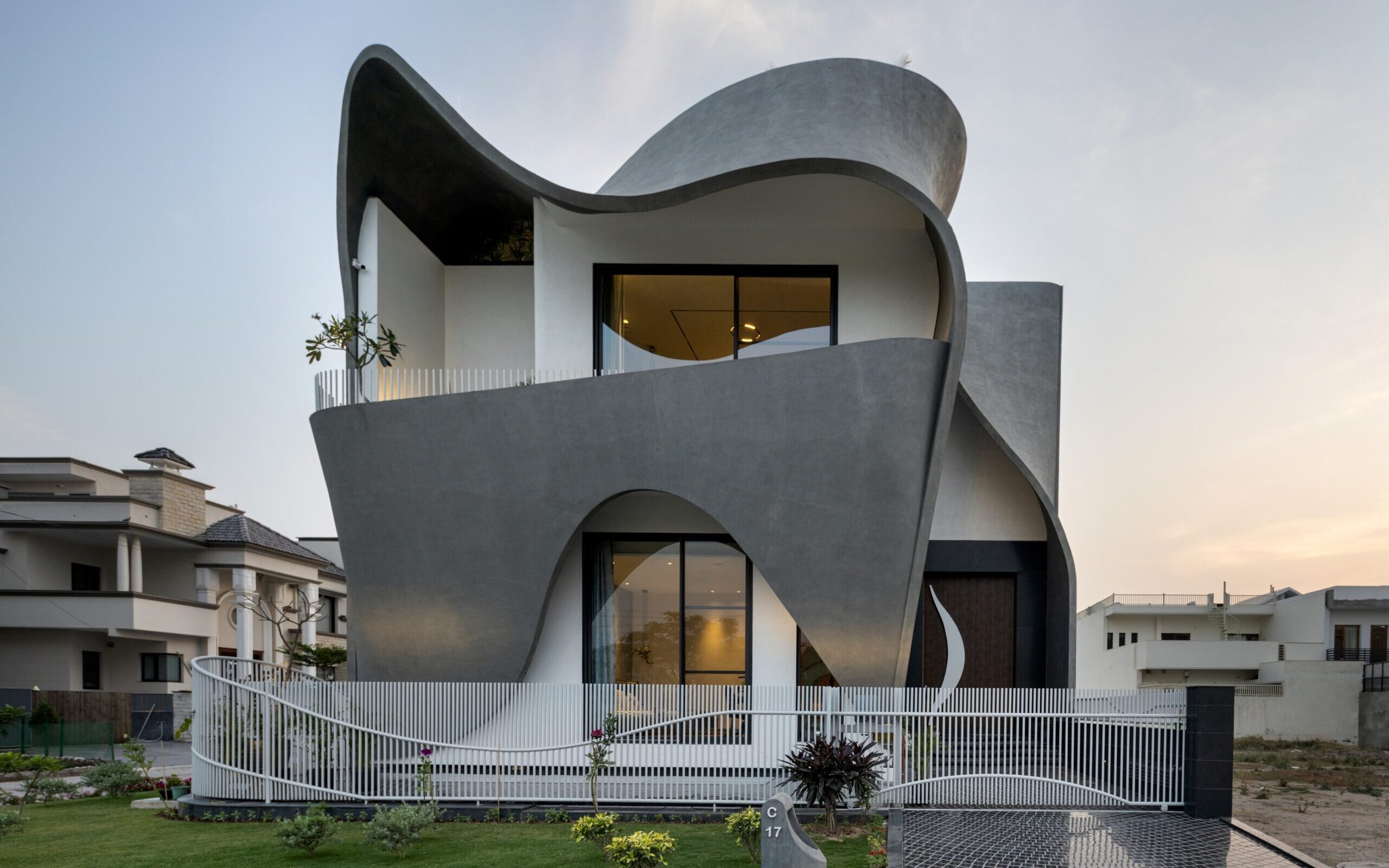
From the garden, Cove House is remarkably restrained. Long horizontal roof planes appear to float above pale stone volumes, while darker textured masonry breaks the expanse of white. Slim columns support deep overhangs and broad panes of glass expose glowing rooms after sunset. There is no ornamental façade announcing luxury from the street. Scale does that job more quietly.
The house is planned in an L-shape, with close to 70 percent of its living spaces looking towards greenery. That statistic becomes far more interesting when seen from inside. In several rooms, a wall is barely a wall at all. Glass runs almost from floor to ceiling, putting sofas, dining tables and beds within sight of lawns, palms and mature trees.
Even the arrival has been turned into a small garden procession. A pergola of dark metal frames the pathway towards a tall timber entrance door, with dense planting hugging either side. Architecture sets up the rhythm; leaves are allowed to interrupt it.
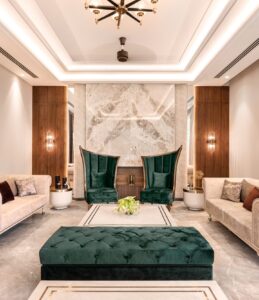
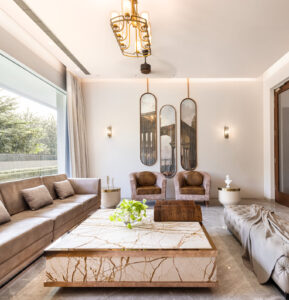
If the exterior speaks softly, the formal living room permits itself a little theatre. Two tall emerald-green wing chairs stand against a large stone backdrop, accompanied by a matching button-tufted ottoman. Cream sofas sit symmetrically on either side, their rolled arms, quilting and turned legs carrying an unmistakably classical manner. Above, a contemporary chandelier loosens the formality.
It is easy to see the old drawing-room tradition here, but nothing has been reproduced literally. There is no attempt to turn a contemporary Amritsar home into an English manor. Instead, familiar codes of formality are picked apart and rearranged.
Emerald replaces predictable burgundy. Pale upholstery takes the place of heavy brocade. Grey marble cools the composition. Timber panels introduce warmth without overwhelming it. The effect feels rather like dressing an old aristocrat in a very good contemporary suit.
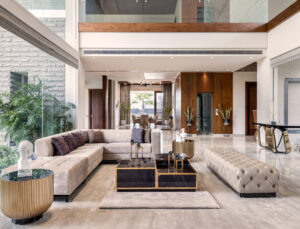
Elsewhere, the mood becomes considerably more relaxed. The double-height family living area is furnished in creams, taupes and warm metallic tones, with a generous sectional sofa, curved occasional chairs, a deeply buttoned bench and black stone tables edged in gold.
Yet the most important piece of furniture may be the garden outside. An enormous glass opening fills one side of the room, turning trees and lawn into a constantly changing backdrop. Tropical planting presses close to the glazing, while the double-height volume pulls daylight deep into the house. On another side, a rugged dark stone wall rises through the space, giving all that glass and polish something deliberately coarse to push against.
This is where Cove House feels most contemporary. The room is undeniably luxurious, but its scale is made bearable by the landscape. Instead of filling every large wall, the architects frequently let a window do the decorating.
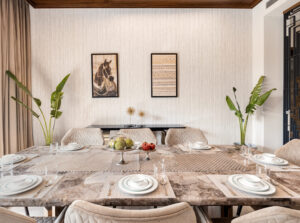
The dining room changes the temperature again. Here, timber travels overhead rather than merely appearing as furniture. A warm wooden ceiling caps the long marble dining table, while slender linear lights cut through it. Quilted cream dining chairs soften the stone below, and tall tropical plants mark the far end of the room.
There are little eccentricities too. Framed artworks, one depicting a richly adorned horse, bring a faint equestrian note into an otherwise polished contemporary setting. A sculptural console with looping metallic legs sits against the wall like jewellery writ large. It is formal enough for a long Punjabi dinner, but not so formal that one is afraid to move a chair.
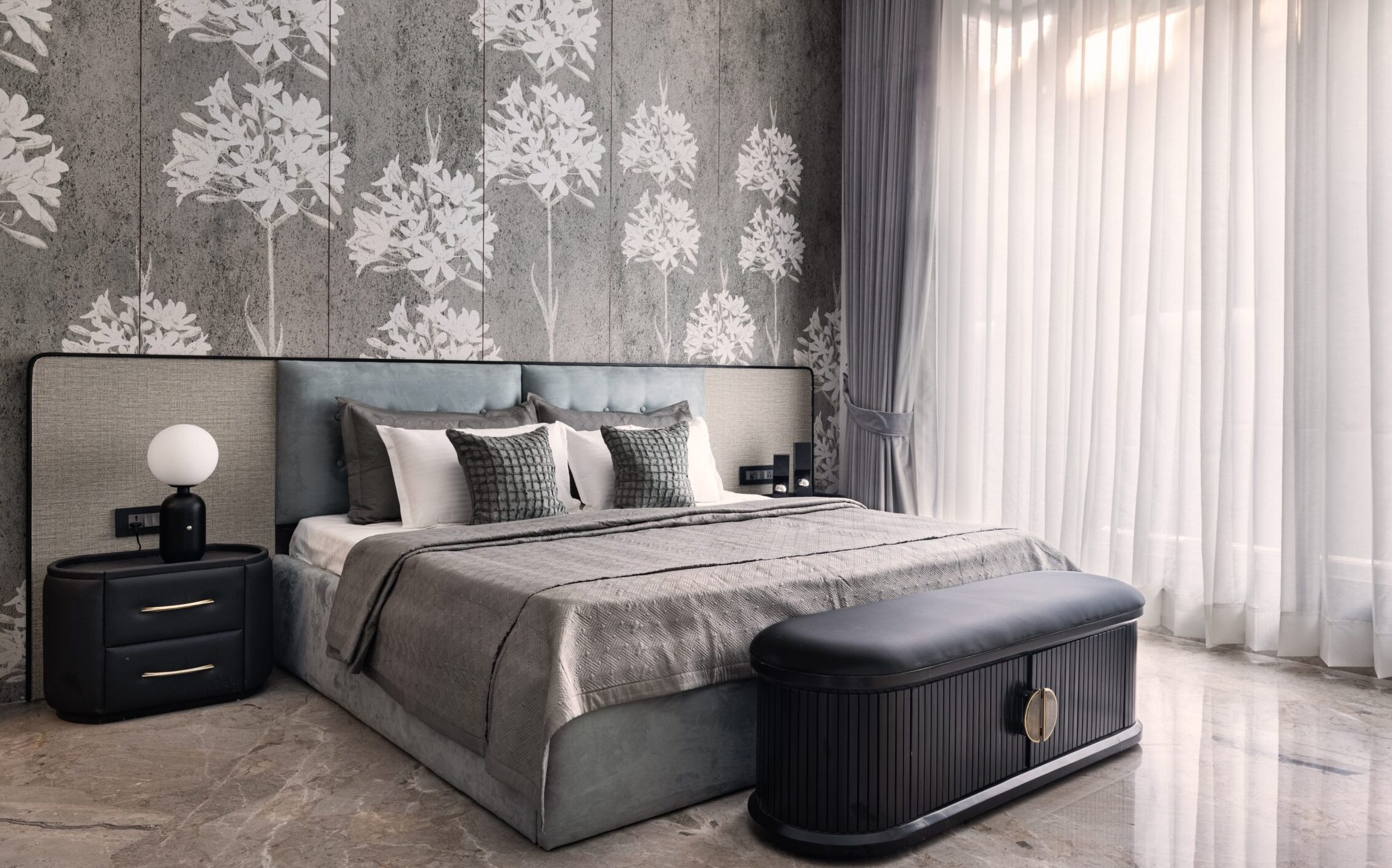
The bedrooms are where the palette begins to play. One is almost entirely composed in grey, from its bedding and curtains to the oversized botanical wall behind the bed. Rather than relying on colour, the room builds interest through scale: enormous pale flowers appear across a charcoal-grey ground, while a powdery blue-grey upholstered headboard provides the gentlest interruption.
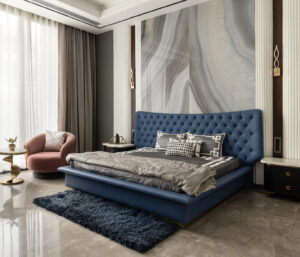
Another bedroom is decidedly more flirtatious. A saturated blue button-tufted bed sits against a wall of swirling grey stone, while two dusty rose armchairs occupy the window corner. Black bedside tables, touches of gold and a deep blue rug sharpen the softer shades.
It is here that the house’s relationship with colour becomes clearest. Pastels are not used to make the rooms sugary. They are placed against stone, black, grey and timber, allowing softness and strength to coexist.
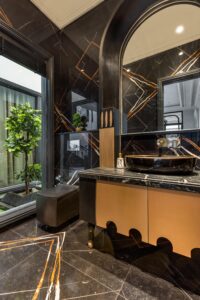
For all the gentler colours, Cove House has not lost its appetite for drama. One powder room is wrapped almost completely in black marble, its white and rust-orange veins darting across the walls and floor like flashes of lightning. A black vessel basin sits on a matching stone counter, while bronze-toned cabinetry and fittings bring warmth into the darkness. An arched mirror stretches dramatically upwards, exaggerating the height of the compact room.
Another bathroom takes precisely the opposite route. White marble with sweeping golden veining covers the floor and walls, paired with a sculptural vessel basin, brushed-gold fittings and softly illuminated mirrors.
One room goes dark, another almost glows. The material may be the same, but the personalities could not be further apart. Cove House never completely abandons the past. Nor does it need to. Instead, Harkaran Boparai allows different generations of taste to occupy the same address.
Perhaps that is Cove House’s more interesting definition of modern luxury. It does not ask Punjab to relinquish its fondness for scale, ceremony or beautiful things. It simply gives them more room, more daylight and a considerably lighter wardrobe.
The prince has not left the building. He has simply opened the windows.