KOLKATA
There is something quietly radical about building a home that doesn’t forget its roots. In a time when houses lean toward glass, gloss and speed, this one in Thrissur chooses patience. It chooses memory. It chooses an older intelligence that understands rain, light, air and the way people actually live.
At 5000 sq ft, this nalukettu does not try to overwhelm. It draws you in slowly, like a story told over many evenings. You do not just arrive. You enter it, layer by layer. And somewhere along the way, you realise this is not just architecture. This is a recall, carefully assembled.
The story does not start on site. It starts with fragments. Sandhya, the homeowner, had spent more than 25 years living outside India. But distance has a strange way of sharpening memory. The house she grew up in did not fade. It stayed intact in pieces. The feel of red oxide floors under bare feet. The echo of voices across a courtyard. The way rain announced itself before it arrived.
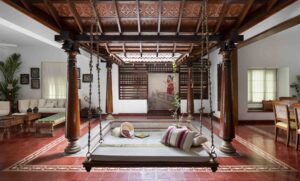
She began collecting before she began building. Windows from Karaikudi, worn but still dignified. Doors that had already opened into other lives. Columns that carried the weight of time with an ease no new material can replicate. She travelled across South India, not as a shopper, but as someone searching for continuity.
So when the plot she inherited from her father in Thrissur finally became the site for her home, the foundation was already emotional before it was physical. When Meera Pyarelal, Founder and Creative Director of Temple Town first saw those collected pieces, the direction was clear. This house would not imitate tradition. It would rebuild it.
The nalukettu is often described as a house with a courtyard at its centre. But that is an incomplete description. The nadumuttam is not a void. It is the point from which everything else makes sense. Built on the principles of Thachu Sasthra, the house understands climate as instinctively as it understands culture. The courtyard pulls in light, releases heat, gathers rain and distributes air. It is not decorative. It is functional in the most poetic way.
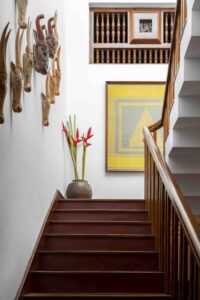
Every room leans toward it. The living space does not close itself. The dining room opens gently. The library, the pooja room, even the corridors seem to acknowledge its presence. Movement through the house is never linear. It loops, pauses, returns. The winding verandas on both floors are not just connectors. They are places in themselves. You walk, you stop, you look out, you sit. The architecture slows you down without asking. And then there is the sound. Rain on clay tiles. Water hitting the courtyard. Footsteps softened by wood. It is a house that understands acoustics without ever speaking about it loudly.
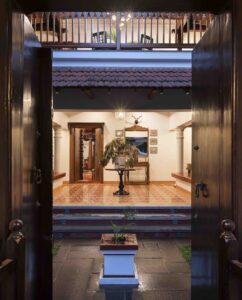
Entry is never abrupt here. The padippura, a roofed gateway, marks the transition from outside to inside. It frames your arrival, narrows your view, prepares you for what follows. By the time you step into the main house, you are already a little quieter.
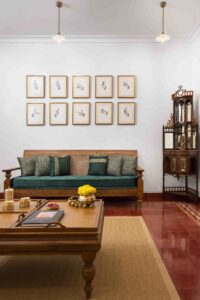
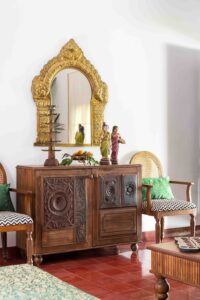
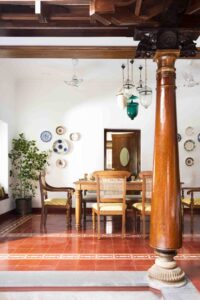
The steep sloping roofs and gabled windows are not aesthetic gestures. They respond to the monsoon with clarity. Water is not resisted. It is directed. The tall pillars hold everything together with a kind of quiet strength that does not need ornamentation. Material choices follow the same logic. Stone, wood and clay are not used to reference tradition. They are used because they belong here. They age well. They respond to weather. They carry memories without effort.
What shifts the narrative from reverence to joy is the way colour is handled. This is not a muted, sepia toned interpretation of a traditional home. It is alive. An emerald green brocade bench catches your eye. Canary yellow block printed dining seats bring in a brightness that feels unapologetic. A green sideboard becomes a gallery of small histories, holding old keys, mirrors and lithographs that seem to whisper among themselves.
The palette does not follow rules. It follows instinct. In the dining room, this instinct turns theatrical. Brass thalis are laid out with care. Kerala fabric napkins sit folded with intention. Lotuses soften the setting. At the centre, an old wooden cooking utensil finds new life as a vessel for tulsi and pink aralipoo gathered from the garden outside. The walls, lined with vintage ceramic plates, hold colour like memory holds detail. Not everything is perfect. That is precisely why it works.
Each room in the house seems to operate at its own pace. The guest bedroom carries a certain gravity. The headrest, detailed with vintage tiles custom made in a temple town, feels anchored in history. It is a room that does not try to impress. It simply holds its ground.
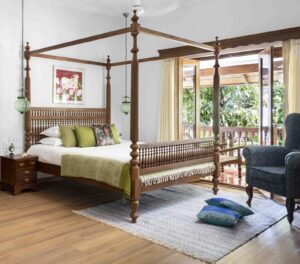
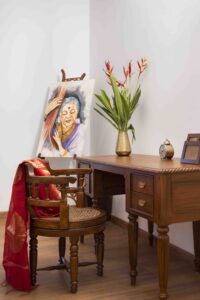
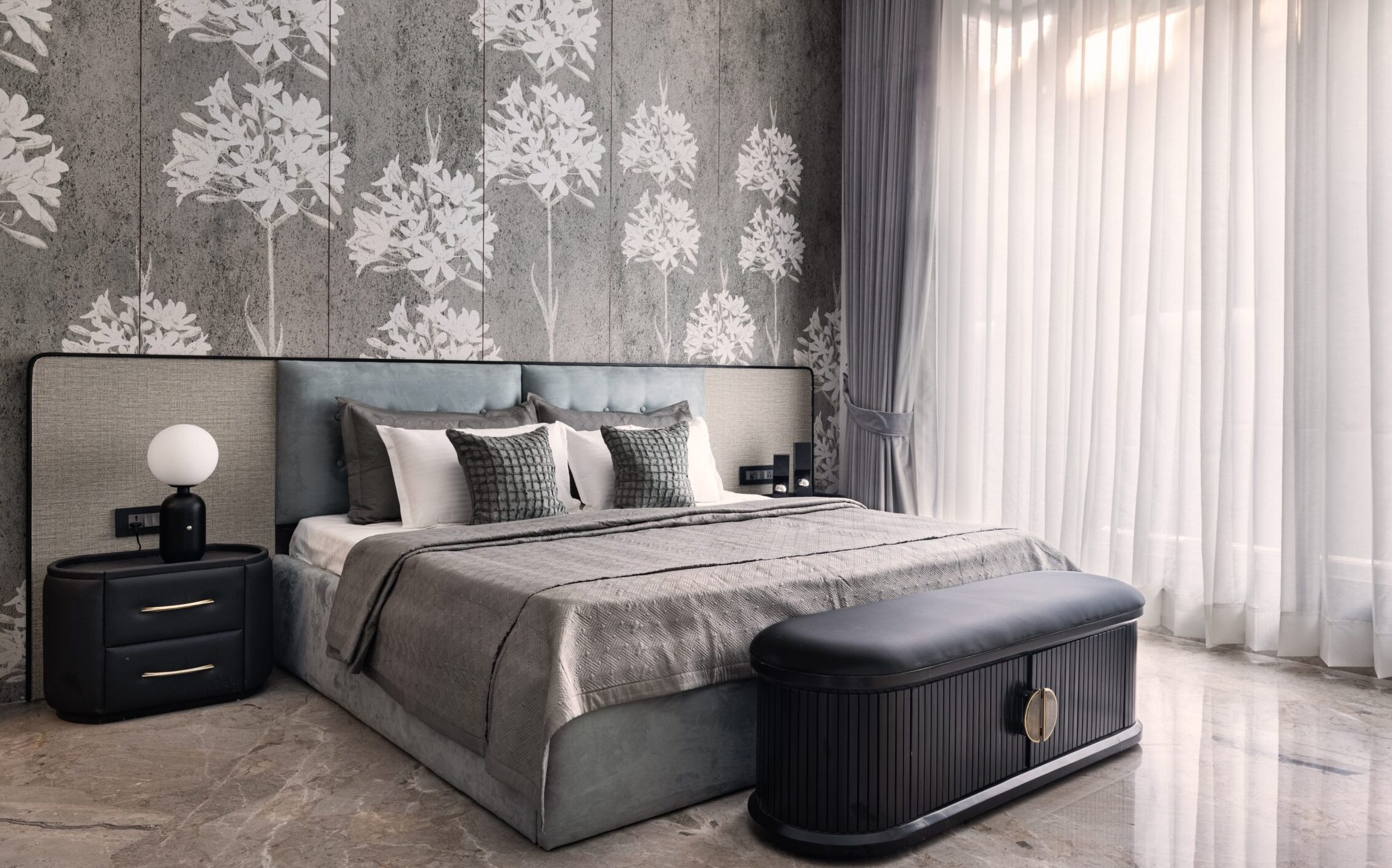
The master bedroom softens the experience. Muted shades, deep maroons, a palette that feels inward looking. A vintage jewellery box doubles as a side table, shifting between function and sentiment with ease. On the wall, an oil painting of MS Subbulakshmi watches over the room. Not as a statement piece, but as a presence that aligns with the homeowner’s daily life. The windows here deserve their own moment. Sourced from Karaikudi and over two centuries old, they filter light differently. Morning light enters sharp and precise. Evening light diffuses into something almost forgiving. You begin to notice time through them.
The son’s room shifts tone again. A four poster bed with traditional Kerala spindles anchors the space. A pichwai style painting introduces another layer of cultural reference, bridging geographies without forcing the connection.
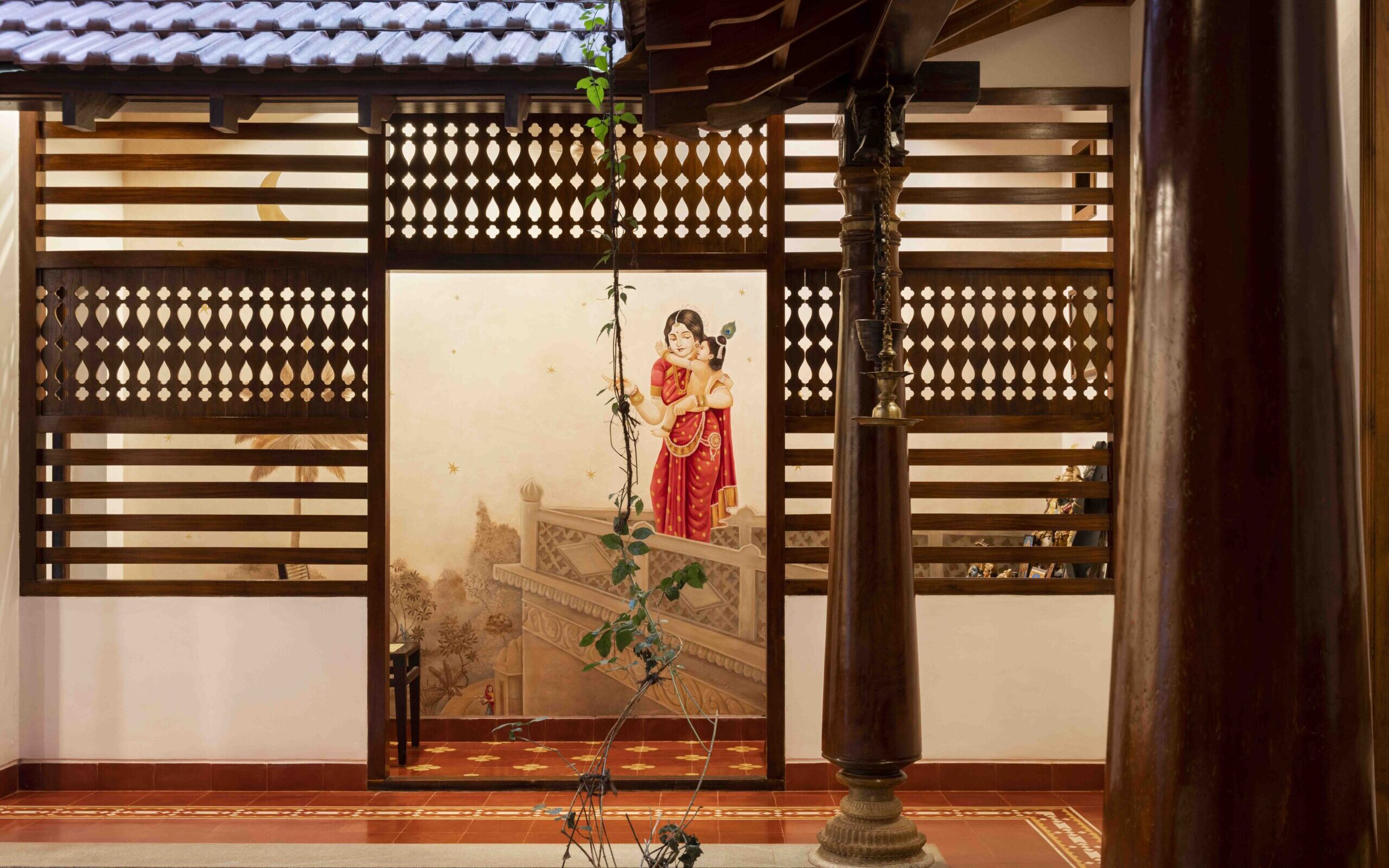
The pooja room and the courtyard together form the emotional heart of the house. Here, a mural of Yashoda and Krishna stretches across the wall, painted by artist S Suneesh. It is tender without being sentimental. For Sandhya, it reflects her own bond with her son. That personal connection gives the artwork a weight that goes beyond visual appeal.
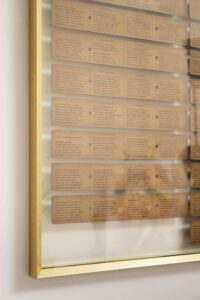
The presence of the Adhyatma Ramayanam Kilipatu by Thunchathu Ezhuthachan deepens this space further. During the month when the Ramayana is traditionally recited over thirty days, this room becomes active in a different way. It is not just a place of prayer. It is a place of continuity. Architecture here does not separate the sacred from the everyday. It allows them to overlap.
In many homes, the kitchen is pushed into the background. Here, it participates. Colour from the rest of the house flows into it without hesitation. It feels connected to the dining space, to the courtyard, to the rhythm of daily life. The work area and laundry sit alongside, integrated rather than hidden. This is a house that understands that function does not need to be stripped of character.
Two and a half years is not a short timeline. But in this case, it feels necessary. This was not a project driven by deadlines alone. It was shaped by attention. Every detail was considered. The size of the cornices. The colour of tassels on paintings. The placement of objects that might seem minor but carry emotional weight. Over time, the relationship between the client and the designer shifted. It moved beyond professional boundaries into something more collaborative, more intuitive. That ease is visible in the final spaces. Nothing feels forced. Nothing feels unresolved.
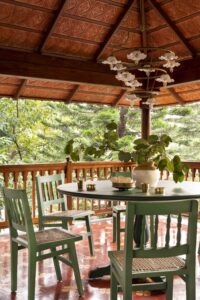
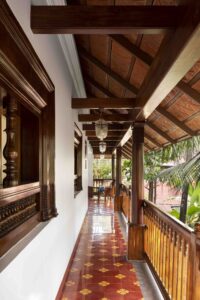
Perhaps the most unexpected aspect of this home is that it is not occupied all the time. Sandhya lives abroad. This house exists in a state of readiness, holding space for her return whenever she chooses it. It does not demand presence. It offers it. Her parents, now in their eighties, move through its spaces at a different pace. The verandas become places to sit and watch the day pass. The courtyard gathers light and memory in equal measure. This is not a house built for display. It is built for return. What makes this home compelling is not just its adherence to traditional principles. It is the way those principles are lived in.
The nalukettu format is respected, but not frozen. Materials are chosen for their relevance, not their symbolism. Colour is embraced without hesitation. Objects are placed with intention, not for effect. Most importantly, the house understands people. It accommodates three generations without reducing them to a layout problem. It allows privacy and connection to coexist. It holds memory without becoming heavy.