KOLKATA
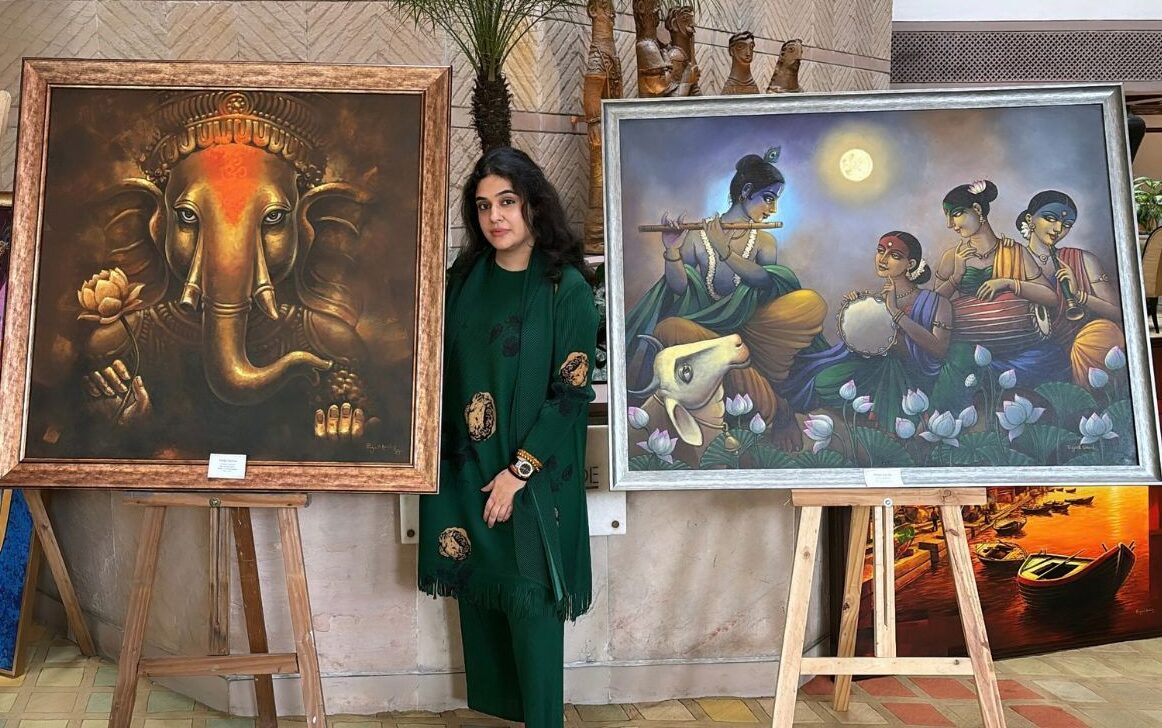
Before Parijat Kanhai knew anything about composition, abstraction or artistic movements, she knew Vrindavan. She knew its saturated colours, its temple rituals, its stories of Krishna and Radha, and the particular way mythology there slips easily into ordinary life. At home, another education was taking place. Paintings were being made around her by a family whose relationship with art stretched back to 1957. For Parijat, art was neither an extracurricular pursuit nor a profession waiting to be chosen. It was simply part of the landscape.
Nearly seven decades ago, her grandfather, Padma Shri Kanhai Chitrakar, developed an elaborate style of painting distinguished by pure gold leaf and semi-precious stones. Kanhai Art subsequently entered significant private collections and homes across India. Her father, Govind Kanhai, continued the artistic tradition and became Parijat’s earliest teacher.
But inheritance can become restrictive if treated too reverently. Parijat chose to stretch hers.
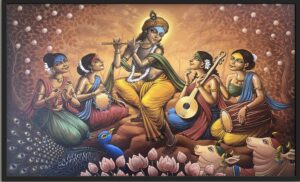
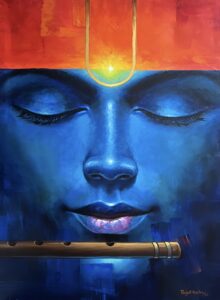
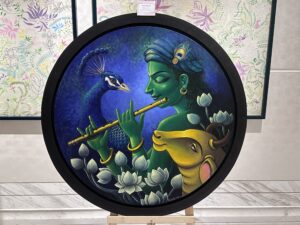
A period studying jewellery design in Jaipur sharpened her eye for ornament, intricacy and composition. When these ideas entered her paintings, they met a vocabulary already populated by Krishna, Radha, Shiva, sacred symbols, nature and Indian mythology. The combination gradually produced something more personal.
Her canvases do not arrive neatly at their final state. They accumulate. Colour covers colour; textures are introduced, reconsidered and worked again. Figures can emerge clearly in one passage and become almost abstract in another. Parijat continues until the emotion she began with becomes visible, even when that means undoing what appeared resolved hours earlier.
Krishna remains a recurring presence, although rarely confined by conventional representation. Growing up in Vrindavan has given her an intimacy with the subject that permits freedom. Divinity can appear through a face, a gesture, a field of colour or a surreal composition.
Behind these spiritual subjects are decidedly earthly concerns. Love and equality recur throughout her work, often carried through allegory. Beauty may invite the viewer closer, but the painting is not necessarily there simply to please.
That tension makes Parijat’s position within the Kanhai lineage particularly interesting. She has inherited almost seven decades of artistic history, yet refuses to use it as a formula.
The family name provides the first chapter. What appears on the canvas now is entirely her own sentence.